Conservation or Reuse in Tangshan Power Plant
Known as the cradle of China's modern industry, Tangshan is the country's basic industrial base for energy, raw materials, steel, and other industries, and has created the first peak of China's industrial culture. To optimise the industrial structure of the city and protect the urban environment, the relocation of heavily polluting industries from the city has become one of the main tasks of Tangshan City, and in the face of much industrial heritage with contemporary significance and preservation value, how to scientifically implement the relocation and transformation of industrial enterprises in the city and find a suitable location for upgrading the functions, improving the functions, optimising the environment and being able to The aim of the design is to find a model of urban regeneration that can carry the city's memory and renew its vitality.
View of surroundings
Macroscale
The Site of Study
The Tangshan Power Station, which started in 1894, is an important power producer in the Beijing-Tianjin-Tangshan region and a major heat source in Tangshan City. Due to earthquake damage and technical needs, the Tangshan Power Station has undergone several technical renovations and expansions on its original site, and most of the old buildings were demolished. The current design area is the plant area, bounded by the New Steep River and Hexi Road, with the mountains to the south and water to three sides, covering approximately 170 hectares.
Landuse

•Before the twentieth century, the power plant was once the largest in the country.
•Power plant made a great contribution to Tangshan during the period of rapid industrial development in Tangshan.
•Even if the power plant needs to be relocated, the site is not included in the heritage and cannot abandon its industrial symbols.
Industrial analysis along the railway line

Value determination
Historical value of the site
-
The modern idea of functional zoning: the Japanese government planned an industrial zone along the banks of the Steep River and located the power plant on the far side of the city.
-
Considerations in the context of the current situation: the transport of coal by the completed railway line.
-
Considerations in relation to the management of the plant: the plant is surrounded by water on three sides, making it easy to manage.
The historical value of the power station
-
Before the twentieth century, Steep River Power Station was the largest power plant in China.
-
The Steep River Power Station made a huge contribution to the rapid industrial development of Tangshan.
-
Tangsteel is an industrial memory that belongs to the whole of China, and the power plant is an industrial memory that belongs to Tangshan.
Medium scale
Functional analysis of the building

Functional analysis of the building
Microscale

Internal architectural analysis

Internal circulation analysis


Skyline Analysis


Development
The livelihoods and economic development needs of the people on the ground
Lifestyle needs
-
Dilapidated public facilities
-
Dirty living space
Development needs
-
Lack of commercial space
-
Facilities need to be updated

Ans : I am not an employee of the power station myself, I live in the compound because my parents used to work in the power station.
Interview 1:Are you an employee of the power station who lives in the compound?
Interview 2:What are your views on the demolition of the power station?
Ans : In favour of the relocation of the power plant, after all the impact and influence it will have on the environment
Scale
Lack of integration of the unplanned shoreline landscape with the landscape of the site
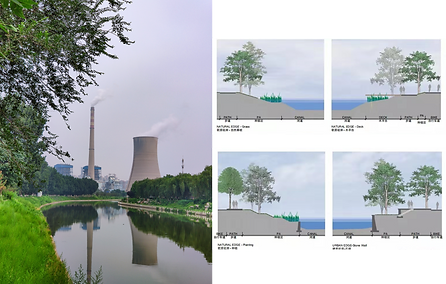
Insufficient combination
-
Insufficient hydrophilicity of the river
-
Lack of trails along the river
-
Barrier of the factory wall
Objectivies & Strategies
Objective level
Operation-oriented
Space
Factory Community
Recreation
Sustainable use
Landscape
Mountain, water tower, restaurant, public space (green space), river bank
Amusement Facilities
Renewable Energy
Parkour, bungee jumping, sliding, rock climbing, high biking
Hydro, wind, solar
Best Practice

Wunderland Kalkar

Annie MG Schmidt House

Ten Drum
Amusement Park & Sustaintable
-
Based on the concept of high land difference, implement planning and design techniques in the site.
-
Reshape the function of the power plant, design recreational facilities and renewable energy into design. Hope to achieve the purpose of sightseeing and sustainability.

